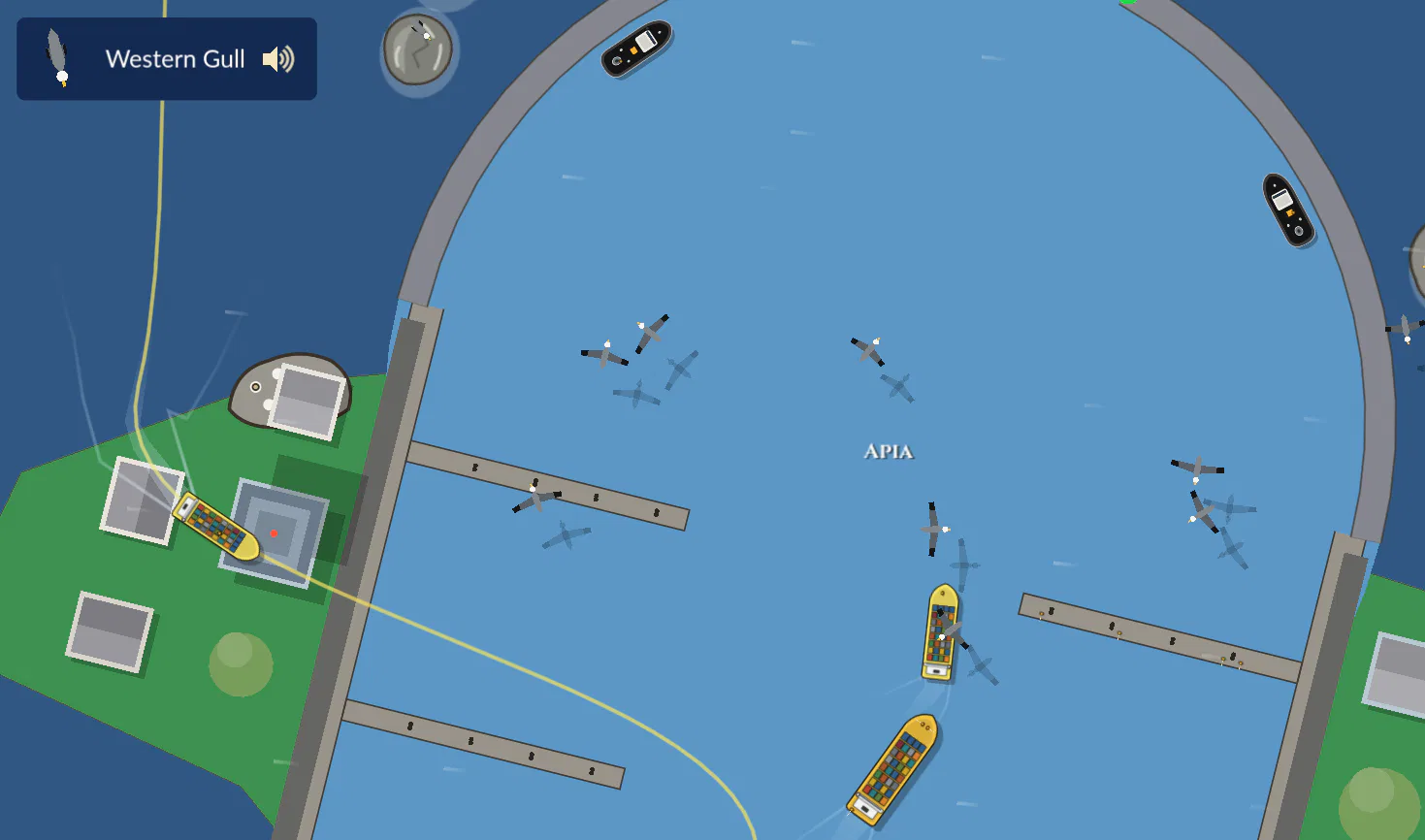
Those runs of street are the port's long-term moorings instead: each becomes a pontoon, a floating walkway along the street's line with dark floats under it and plank seams close in, with finger piers out from both sides and a slip between each finger and the next, every finger and slip only where the water really is and clear of the marina's own ground (the quay, the basin, the harbour inside the jetty), as long as the longest ship of any kind (the Mammoth) and its beam and a gap wide (since 2026-10-13: the moorings are every ship's long-term parking, the recovery boats' too; before, the port's own longest cargo ship), for a ship to come straight in, bow to the pontoon; a cleat at each finger's root, a lamp at each pontoon's end at night. The quay road and the cross roads are laid first, then the avenue and the streets, each keeping clear of the others' fingers; and the side streets' lines along either side of the harbour just outside the quay land (one row at a Small or Medium port, two at a Large, three at a Giant or a hub), so a port with water beside its marina (Shanghai, Singapore, Hong Kong, Auckland, Honolulu, Los Angeles...) gets a mooring field flanking it. A pontoon must lie along a shore or the quay, or touch land at an end (none floats off by itself), and is worth building only for 2 slips or more. The roads keep to their runs on land. Wood at ports of 8 berths or fewer, concrete at the bigger. The side rows start beyond the way ships round the jetty's end (1.5 jetty radii out), and a row only beyond a built row nearer the quay, so no field floats off by itself; a street pontoon stays within 14 units of its own quay (not out by some other islet). With the game's 322 ports, 146 have moorings, about 850 slips in all.
The staging point outside a slip is pulled back along the slip to the last of the water. A mooring with no way to it by water at all (a field on a lake behind the town) is drawn but never given a ship.
A cargo ship lying in port without a berth (waiting for a load, idle, paused, or for fuel money; service ships too, if they fit) takes the first free slip it fits, or if the port has none (or they're full) its spot at the anchorage as before; it sails to it from the entrance out round the jetty's end on its side, round the back of the quay if the slip is behind it, up to the slip's mouth and straight in, and leaves the same way: backing straight out of the slip to its mouth, turning there on its thrusters, and back round by the way it came, at its own speed (its time in to a berth counts all of it, as does its time out to the moorings, so it never hurries). An idle or paused ship stays at the moorings, its long-term parking, till it has somewhere to go: it isn't brought in to a pier while the port has room (only running ships are), and one done with its stop pulls out to the moorings. Tugs still moor along the jetty's arms.
 Maritime Empire