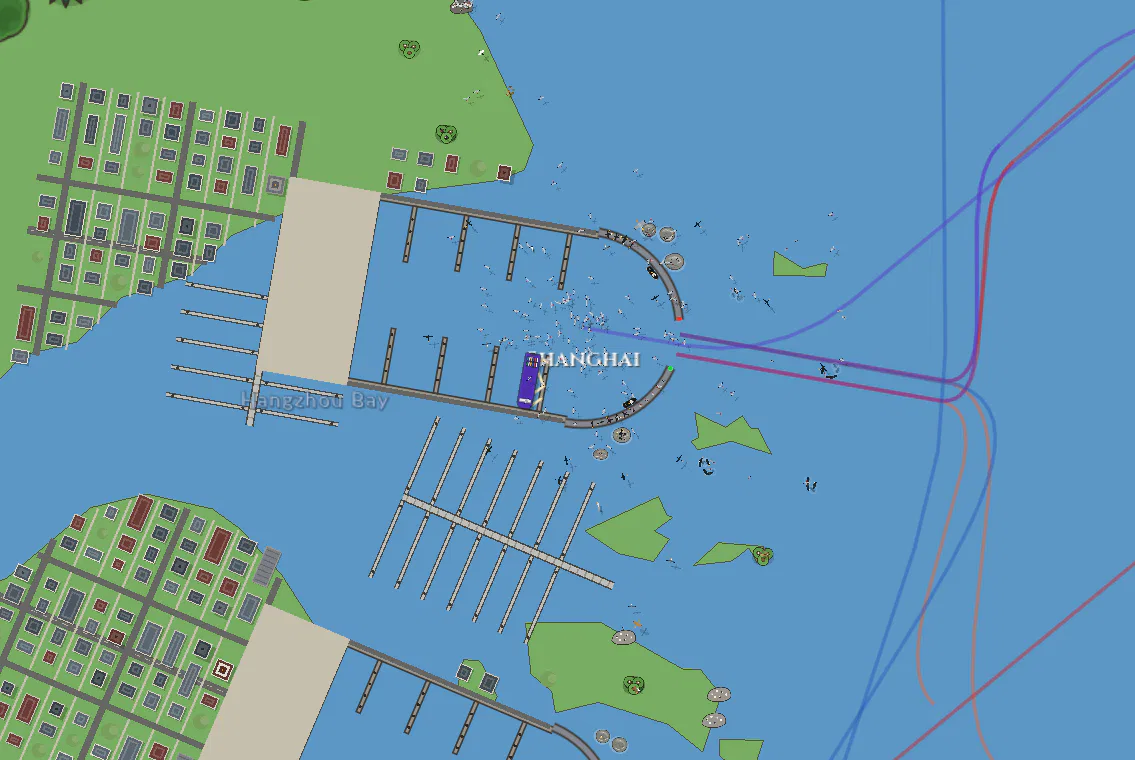
Just for looking at (they never affect ships). Every bird is a permanent map object: one of the wildlife's colonies' birds (see Wildlife), always somewhere, doing something, never appearing or vanishing. Its day goes in spells. Its position is worked out from the bird clock alone (real seconds, so they carry on while the game's paused, at their own pace at any game speed), so it's the same whoever looks, and nothing is saved. By night (before 5:30 and after 20:00 by the sun; night herons the other way round) birds sleep at their colony's home; sea ducks and seabirds out at sea sleep on the water.
Gulls: 15 species, each in its real range (Herring, Great Black-backed, Lesser Black-backed, Yellow-legged, Black-headed, Ring-billed, Laughing, California, Western, Glaucous-winged, Black-tailed, Heermann's, Sooty, Kelp and Silver gulls), some moving between summer and winter ranges. Every port has its gull colony (see Wildlife). By day each gull circles the port, perches on the port's rocks (each bird its own spot, the rocks' filled first, then the breakwater's arms), swims off it, follows a ship within 60 km of the port (flying behind and off to one side of it, wherever it goes, till the spell ends), or rests at the colony; by night most sleep at the colony and a few sit on the sea.
Seabirds: 16 species (Andean and California condors; Wandering, Black-browed and Laysan albatrosses; Arctic, Common, Caspian and Royal terns; Brown, Great White and Australian pelicans; Sooty and Manx shearwaters; Magnificent and Great frigatebirds, with their long angular wings, forked tails and scarlet throats), each with seasonal ranges they migrate between (Arctic Terns from pole to pole, Sooty Shearwaters round the Pacific). Each wanders out over the sea from its colony a stretch at a time (within 60% of its range, then up to 120 km about that), gliding in wide circles and sitting on the sea (paddling about now and then; a frigatebird never settles on the water and soars on through the night instead), and takes up following a ship that passes within 250 km (steadily by species and ship), till its spell ends; by night it sleeps on the water where it is.
Raptors: 15 eagles, hawks and the osprey, drawn with broad, finger-tipped wings (an osprey's bent at the wrist), a fanned tail and a hooked bill: Bald, White-tailed, Steller's Sea, African Fish, White-bellied Sea, Golden and Wedge-tailed eagles; the Osprey; Red-tailed, Rough-legged, Swainson's, Harris's and Cooper's hawks, the Northern Goshawk and the Common Buzzard; each with its seasonal ranges (Swainson's hawks migrate from the Great Plains through Central America and Panama to Argentina; Steller's sea eagles winter on Hokkaido's drift ice; Rough-legged hawks breed on the Arctic tundra; Peregrine falcons on sea cliffs the world over, Gyrfalcons round the Arctic and Brown falcons across Australia, with swept pointed wings and long narrow tails). They never follow ships. By day each perches on the land behind its port, soars high in slow circles over the land, or hunts out over the sea (circling, now and then plunging in with a splash and climbing again); by night it sleeps at its eyrie. A bird's shadow falls further off the higher it flies.
Owls (raptors of kind Owl): 8 of them, drawn with a big round head (a pale facial disc, big eyes, ear tufts on the horned owls), broad rounded wings and a short round tail: Snowy (the Arctic, south in winter to North America's coasts, Scandinavia, Russia and Hokkaido), Barn, Short-eared, Great Horned, Eurasian Eagle-, Blakiston's Fish, Pel's Fishing and Powerful owls. They go about it as the other raptors do, but by night, and sleep on their perches by day. A port has up to one owl species besides its 2 other raptors. They have no calls yet.
Cormorants: 9 species (Great, Double-crested, Pelagic, Neotropic, Cape, Japanese, Little Pied and Guanay cormorants, and the European Shag), each where it really lives. Drawn with a long neck stretched out ahead, a small head (a pale cheek or bright throat on some) and a thin bill. A colony keeps together: perched on the rocks or the breakwater (now and then holding their wings out to dry), swimming low off it and diving for fish (a dark shape under a ripple while under), or circling wide round the port together; by night they sleep at their colony.
Herons, egrets, bitterns and cranes: 22 species (Grey, Great Blue, Purple, Goliath, Striated and Black-crowned Night herons; Great, Little, Snowy, Cattle and Reddish egrets; Eurasian, American, Least and Australasian bitterns; Common, Sandhill, Red-crowned, Whooping, Grey Crowned, Sarus cranes and the Brolga), each where and when it really is (Whooping Cranes winter only at Aransas on the Texas coast; Red-crowned Cranes on Hokkaido; Common and Sandhill cranes migrate). They live along their port's shore either side of its marina: the shore is found once per port from the land as drawn (the water's edge, and a spot inland), never on a marina's quay. Drawn standing from above with a long shadow cast to the side (legs, neck and head: they're tall), the body with folded wings, neck and dagger bill; in flight with broad fingered wings and legs trailing (a crane's neck stretched out, a heron's drawn back). By day each stands at the water's edge, neck poised, or stalks slowly along it, flying between spots along the shore; a bittern always stands hidden in a clump of reeds swaying in the wind, bill to the sky; by night they sleep hunched at the heronry.
Birds that fly in Vs in life do so on their migrations (the leader at the point, the rest back along either arm by turns, 4.5 km apart): each bird flies from wherever it was into its place over the first 25 s.
Sea ducks: 9 eiders and scoters (Common, King, Spectacled and Steller's eiders; Common, Black, Surf, White-winged and Velvet scoters), each with its real migration: breeding on Arctic and northern coasts and lakes in summer and wintering on northern coasts (the whole world's Spectacled Eiders in a few holes in the Bering Sea ice; Steller's Eiders in Norway's Varangerfjord; scoters off Britain, both North American coasts, and Japan). A raft lives off its port day and night, the ducks together on one of the sea spots off it, drawn swimming from above, drakes in their pattern (eiders white-backed with black sides and green napes, King Eiders with blue-grey heads and orange bills, scoters black with bright bills, white face and wing patches) and hens brown, drifting and turning a little; by day each dives in its own time; now and then the whole raft flies round the port together and settles somewhere new.
Bird seasons: the data's months read in as floats, so a season's months are matched as numbers either way.
On the World map, each bird is drawn at its size in the world with the ships: a dot of its back's color while it's under 4 px across (from 1.6 px), then its drawing from above in its species' colors (mantle, head, wingtips, bill), flapping, gliding or folded, with its shadow on the water further off the higher it is, turned the way it's heading. Clicking one opens its colony's popup (remembering the bird clicked): the species with its picture, name, Latin name, how many and what they're doing now ("5 circling the port, 4 perched, 3 resting at home"), or where they're flying to on a migration. A port's or ship's birds list the same way. Each species has a Follow button at its right: the map follows one of its birds (the one clicked, if the popup was opened by clicking a bird; else one out and about if any is, one following the ship for a ship's birds), keeping it in the middle wherever it goes, zoomed in 3 times as close as when following a ship; the button reads Following while it does. Port popups say "Gulls: Herring Gull (16), Yellow-legged Gull (8)" (each species once, all its flocks there added up, the most first); ship popups say "Following: Herring Gull (3), Wandering Albatross (2)" while any are following it.
Field guide: the square paw-print button at the map's top right opens a guide to every bird (gulls, seabirds, raptors, cormorants, herons, egrets, bitterns and cranes, and sea ducks), sea animal (with the waters its pods visit) and land animal on the map (with its group size and habits), a tab each, each with its picture, where to see it and a fact. Esc, X or a click outside closes it.
Bird boosts: every species that follows ships gives the ship a little of its own, four shares: speed gained, wear saved, fuel saved, and storm shelter (the storm's slowing and wearing shrugged off in part). Gulls are small change (1-2% of one or two), terns are quick (+2-3% speed, a little fuel), pelicans save fuel and wear (2-4% each), condors keep a ship sound (3-4% less wear), frigatebirds and shearwaters shelter it (15-20%), and the albatrosses are the prize (the Wandering Albatross +4% speed, 2% fuel, 25% shelter). A species counts once it has a bird aboard, 15% more for each bird up to three more; all the species following add up, capped at +12% speed, 25% wear, 15% fuel and 60% shelter. Looked at again every 5 s of play; applied in the storm factors (speed, wear, shelter) and the ship's fuel burn; the ship's popup says what its followers give it. In a Divine Actions game the divine blessing comes on top.
 Maritime Empire